
Diagnose the fault before replacing the box
Cooling System Installations and Repairs
Cooling fails on the hottest week of the year, in the afternoon, usually on the day you have people over. Pivot runs repair work out of Altona across the western suburbs, and through summer we triage calls so houses with no cooling at all and vulnerable occupants get seen first.
- REC 37223
- Melbourne west
- Fixed quotes
The short answer
An air conditioner that runs but does not cool usually has one of four faults: low refrigerant from a leak, a failed capacitor or contactor, a blocked filter or coil restricting airflow, or a control board or sensor fault. Refrigerant work must be carried out under an ARC licence, and topping up gas without finding the leak is a temporary fix. Diagnosis takes most technicians 30 to 60 minutes on site.

From one of our jobs
Diagnosing a system before quoting a replacement
Photographed on site in Melbourne’s west. REC 37223.
This page is about the repair side and about installs that follow a failure. If you are researching a brand new system from scratch, the split system and ducted cooling pages cover the design decisions in more detail.
Before you call, three things worth checking
A meaningful number of summer callouts are solved in five minutes, and we would rather you keep the money. Check the switchboard for a tripped breaker or safety switch. Check the filters behind the indoor head or at the return air grille, because a blocked filter starves the coil and can ice it up until nothing comes out. And check the remote or controller is in cool mode with the setpoint below room temperature, not in fan, dry or a leftover timer.
If the outdoor unit is not spinning at all, or the breaker trips again immediately after resetting, stop there. Repeated resets on a compressor fault do further damage.
The faults we find most often
Diagnosis is a process of elimination with gauges, a meter and a clamp. We measure the temperature split across the indoor coil, check running current against the nameplate, test capacitors under load and read pressures before deciding anything.
Low refrigerant charge
Almost always a leak, since a sealed system does not consume gas. We find and repair the leak, then recharge by weight. A top up alone will fail again.
Failed run capacitor
Common, cheap, and the reason many units hum but will not start. Capacitors degrade with heat and age, and summer is when they give up.
Contactor or relay
Pitted contacts stop the compressor energising or leave it chattering. A visible symptom is the fan running while the compressor never engages.
Iced indoor coil
Caused by restricted airflow or low charge. The unit blows barely cool air, then water appears when the ice melts.
Blocked condensate drain
Water in the ceiling, a full safety tray or an overflow switch shutting the system down as designed.
Control board and sensors
Error codes, phantom shutdowns, or a unit that will not respond to the controller. Photograph the code before power cycling.
Outdoor fan motor
Head pressure climbs, the compressor cuts out on protection, and the unit runs for twenty minutes then stops.
Why we do not just top up the gas
A refrigeration circuit is sealed. If it is short of refrigerant, there is a hole in it somewhere, usually at a flare, a braze joint, or a coil that has corroded. Adding gas without addressing that means paying for refrigerant that will be in the atmosphere within a season, and it is poor practice under ARC licensing.
We pressure test, use electronic detection or dye where required, repair the leak, evacuate the system to remove air and moisture, then weigh in the correct charge. It costs more on the day than a top up and less over two summers. Where the leak is in an old coil and the repair cost approaches replacement, we say so.
Repair, or replace and start again
Age is the first filter. Under about eight years, most faults are worth repairing. Over twelve, a major failure such as a compressor or a leaking indoor coil rarely justifies the spend, particularly on systems still running R22 or older R410A equipment where parts and gas are getting expensive.
The second filter is what the replacement buys you. A current inverter system uses materially less power than a fixed speed unit from 2010, is quieter, and if it is reverse cycle it takes over your winter heating as well. When we quote a replacement we include what the new system will cost to run so the comparison is complete.
How a Pivot repair call runs
You get a booking window rather than a vague day, and a call before we arrive. On site we diagnose, then explain what we found and what it costs before doing the work. Common parts such as capacitors, contactors and fan motors are on the van, so a good proportion of repairs finish on the first visit.
Anything electrical is completed under REC 37223 with a Certificate of Electrical Safety, refrigerant work is done under ARC licence, and the labour carries our 100% workmanship guarantee. If we recommend replacement rather than repair, the diagnostic fee comes off the replacement if you proceed with us.
Book a repair now if you see any of these
- 1Breaker or safety switch trips whenever cooling starts
- 2Ice on the copper pipework or the indoor coil
- 3Water dripping from the indoor head or staining the ceiling
- 4Burning, hot plastic or sharp electrical smell
- 5Outdoor fan running while the compressor never engages
- 6Loud grinding, screeching or a new rattle under load
- 7System runs for fifteen to twenty minutes then shuts down repeatedly
On the job
Cooling System Installations & Repairs in Melbourne's west
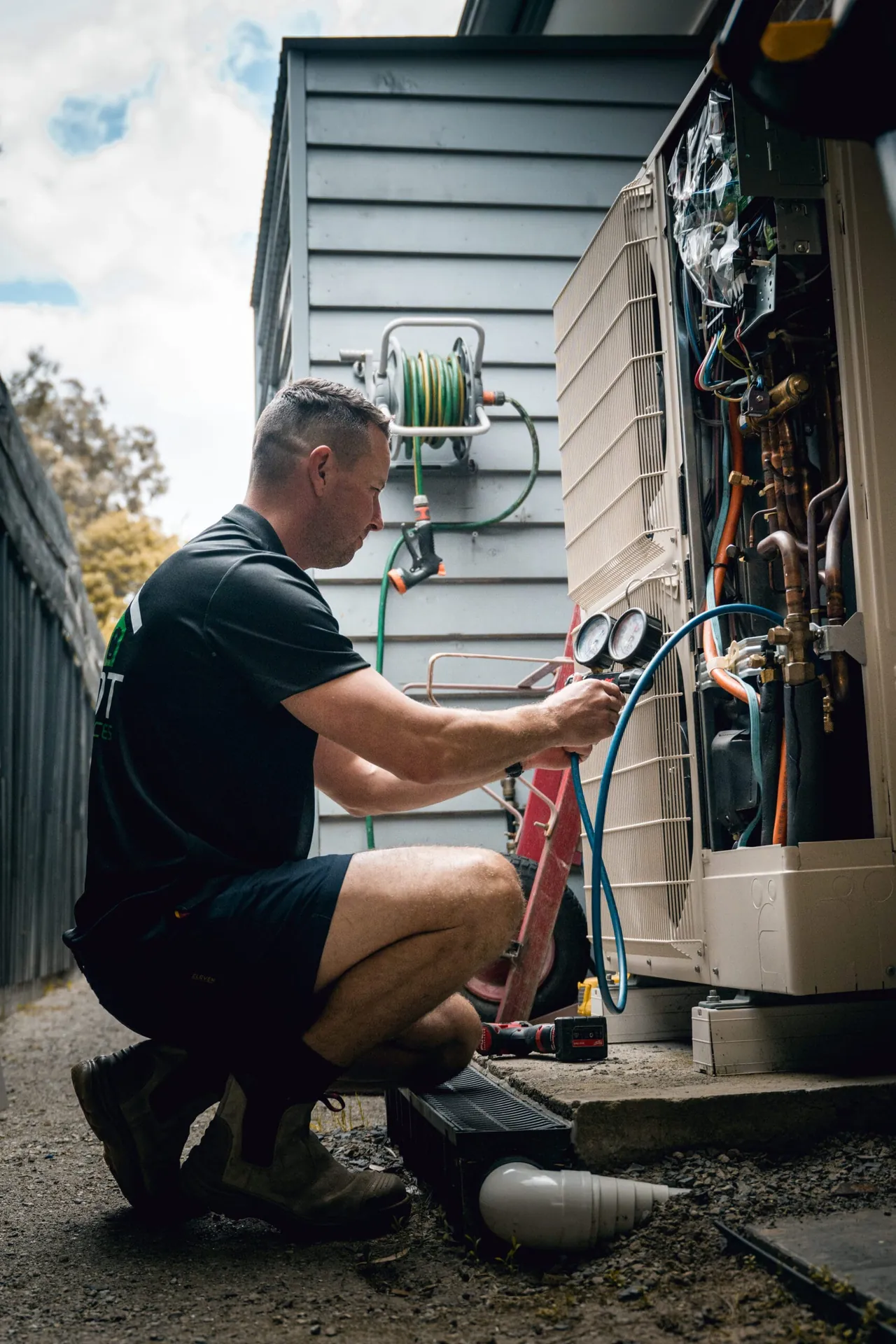
Gauges on during a service, checking the charge 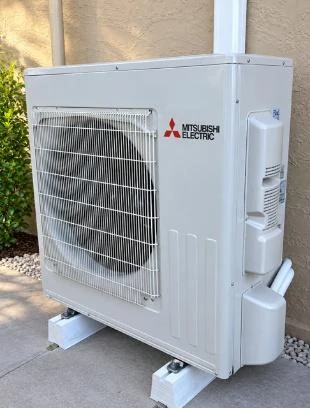
Outdoor units set on level mounts, clear of the fence line
Licensed and accredited work by a local team. Read about Pivot Trade Services or see recent jobs across the western suburbs.
Answers
Frequently asked questions
Small electrical parts such as capacitors and contactors typically land between $250 and $450 fitted, including the diagnostic. Fan motors and control boards run higher. Leak repair and recharge depends on where the leak is and how much refrigerant the system holds. You get the price before we start the work, not after.
Yes. Most of our repair work is on other installers equipment, across all the major brands. If a unit is still inside its manufacturer warranty we will tell you, because in that case the right move is often a warranty claim through the original installer rather than a paid repair.
We keep emergency capacity through summer and prioritise homes with no cooling at all, elderly residents or young children. Call 0401 500 446 or 1300 748 688 early in the day if you can. We will give you an honest window rather than promising an afternoon we cannot make.
Classic high head pressure symptom. Common causes are a dirty outdoor coil, a failing outdoor fan, restricted airflow around the unit, or an overcharge. The system is protecting itself. Left running like that it will eventually cost you a compressor, so it is worth attending to early.
Yes, splits, multi head systems and ducted refrigerated cooling. Because we are electricians as well as refrigeration technicians, circuits, isolators and switchboard work are handled in house rather than subcontracted, and the system is commissioned, tested and certified before we leave the site. That also means one point of contact if anything needs attention later.
Ten to fifteen years for a quality unit that has had filters cleaned and the outdoor coil kept clear. Coastal installs in Altona and Williamstown corrode faster and can be closer to ten. Past that, the money is usually better spent on a new inverter system than on a second major repair.
Book cooling system installations & repairs
Tell us what you need and we will give you a written price, not a range that moves on the day.
- Free
- On-site quotes
- Fixed
- Written pricing
- 100%
- Workmanship guarantee
- 5.0★
- 73 Google reviews