
The one device that has to work at 3am
Smoke Alarm Installation and Testing
A smoke alarm is the cheapest life safety device in a house and the one most often left to sort itself out. Alarms expire, batteries die, dust and insects get into the chamber, and the first anyone notices is a chirp at three in the morning that gets silenced by pulling the battery out.
- REC 37223
- Melbourne west
- Fixed quotes
The short answer
Hardwired smoke alarm installation in Melbourne typically costs $120 to $250 per alarm. Alarms must comply with AS 3786 and be installed on every storey, in or near sleeping areas and in paths of travel. Victorian rental providers must test each alarm annually and replace the batteries yearly. Every smoke alarm, including 10-year sealed lithium units, must be replaced 10 years from its date of manufacture regardless of whether it still sounds when tested.
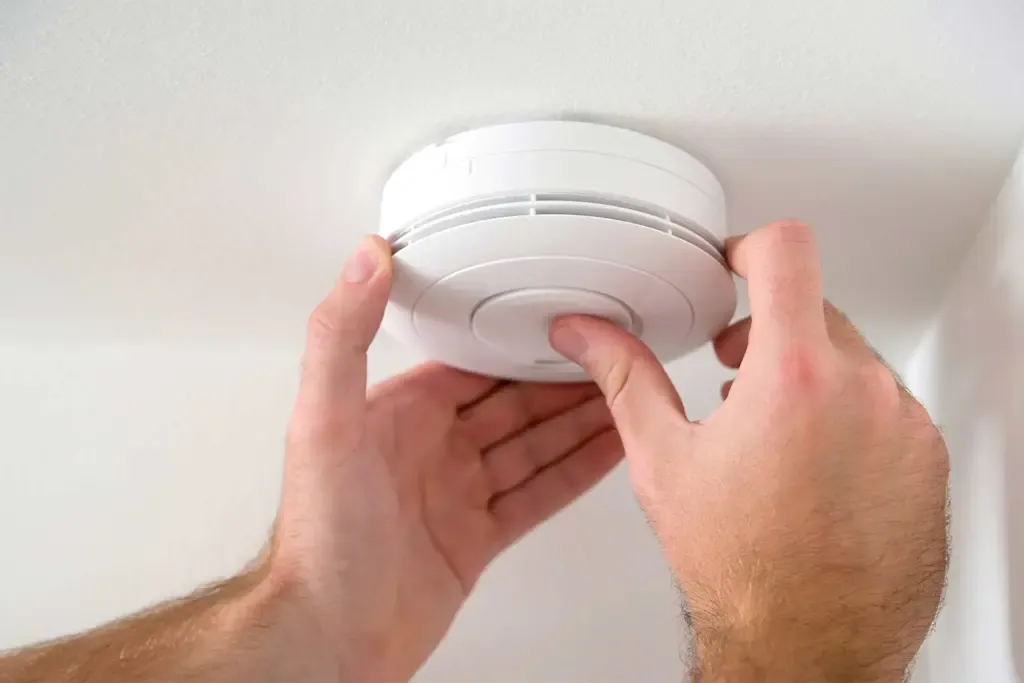
We install, replace, interconnect and test alarms in owner-occupied homes and rental properties across Melbourne's west, and we leave you with a written record of what was done and when the alarms expire.
Photoelectric or ionisation
Ionisation alarms respond quickly to fast flaming fires with little smoke. Photoelectric alarms respond much faster to smouldering fires, which is the type that kills people in homes because it develops slowly overnight in furniture, bedding and wiring.
Fire services across Australia recommend photoelectric alarms for residential use, and every alarm we install is photoelectric and compliant with AS 3786. Photoelectric alarms are also far less prone to the cooking nuisance alarms that lead people to disable them, which matters more than any specification, because a disabled alarm protects nobody.
Where alarms have to go
Placement is not a matter of preference. Alarms are required on every storey of a home, in or near each sleeping area, and in the path of travel people would use to leave the building. A single alarm in a hallway of a two-storey house does not meet that.
There are also practical placement rules that get ignored. Alarms should be at least 300mm from a wall or corner and away from the dead air space where a wall and ceiling meet, because smoke does not circulate there. They should not sit directly next to a bathroom door, an air conditioning outlet or a ceiling fan, and they should be far enough from a cooktop to avoid constant nuisance alarms while still covering the area.
Every storey
Including basements and split levels, not just the level the bedrooms are on.
Bedrooms and hallways
Inside or immediately outside sleeping areas, so an alarm wakes a sleeping person through a closed door.
Away from corners and vents
At least 300mm off walls, and clear of air conditioning outlets and fans that push smoke away from the sensor.
Clear of the kitchen and bathroom
Far enough to avoid steam and cooking fumes, close enough to still detect a real fire early.
Hardwired, interconnected or battery
A 240V hardwired alarm with a battery backup is the standard for new work and the right answer for most homes. It cannot be disabled by removing a battery and it does not stop working when a battery dies.
Interconnection is the upgrade that actually saves lives. When alarms are interconnected, one detecting smoke sounds every alarm in the house. In a two-storey home, that is the difference between a smouldering fire in the lounge waking someone upstairs or not. Victorian requirements for interconnection depend on when the home was built or significantly renovated, with homes built or substantially renovated since 2014 required to have interconnected alarms in some circumstances. Interconnection can be wired or wireless, and wireless is what makes retrofitting practical in an existing house without pulling up floors.
240V hardwired with battery backup
Standard for new builds and renovations. Powered from a lighting circuit with a sealed backup battery.
Wireless interconnected
Alarms talk to each other by radio. Ideal for retrofits where running cable between levels is impractical.
10-year sealed lithium
Battery only, but with a non-removable cell that lasts the life of the alarm. Suits properties with no accessible ceiling wiring.
Replaceable battery alarms
The lowest cost option and the one most likely to be found with the battery removed. We do not recommend them.
Rental properties in Victoria
Victorian rental law places specific duties on rental providers. Smoke alarms must be tested at least annually, and the batteries must be replaced yearly as part of the same duty. Repairs to a smoke alarm are an urgent repair, so a faulty alarm is not something that can wait for the next inspection cycle.
For agents and rental providers we do this as an annual round with a written report per property, listing alarm locations, manufacture dates, expiry dates, test results and battery changes. That report is what you produce if a claim is ever made, and it is the reason we photograph and record rather than just ticking a box.
The 10-year rule nobody knows about
Every smoke alarm has a date of manufacture printed on the back and must be replaced 10 years from that date. This applies to sealed 10-year lithium units and to hardwired alarms alike. The sensing chamber degrades with age, dust and humidity, and an alarm that still beeps when you press the test button may no longer detect smoke reliably. The test button confirms the sounder and battery, not the sensor.
When we replace alarms we write the replacement date on the unit so that the next person does not have to get a ladder out to work it out. If you have not looked at yours, take a photo of the back of one. If the date is before 2016, they are due.
Your alarms need attention if
- 1The date on the back is more than 10 years ago
- 2An alarm chirps intermittently, especially at night
- 3Someone has removed a battery to stop nuisance alarms
- 4There is no alarm on one storey of the house
- 5The alarms are not interconnected in a two-storey home
- 6You are a rental provider and no test has been recorded this year
- 7An alarm is discoloured, yellowed or covered in dust
Licensed and accredited work by a local team. Read about Pivot Trade Services or see recent jobs across the western suburbs.
Answers
Frequently asked questions
It is almost always the battery. Temperature drops overnight, and a battery near the end of its life loses just enough voltage in the cold to trigger the low battery chirp, then recovers as the house warms up. Replace the battery rather than removing it. If the alarm keeps chirping with a fresh battery, the alarm has reached the end of its life and needs replacing.
At minimum, one on every storey, and one in or near each sleeping area, plus coverage of the path of travel to the exit. A typical three-bedroom single-storey home usually ends up with three: one in the hallway outside the bedrooms and one at each end of the living area. A two-storey home needs alarms on both levels, ideally interconnected.
It depends on the age of the building and what work has been done. Homes built or significantly renovated in Victoria since 2014 require interconnected alarms in some circumstances, and interconnection is standard for new work. In an older home there is generally no obligation to retrofit, but wireless interconnection is inexpensive and it is the single biggest improvement you can make to an existing set of alarms.
A battery-only alarm can be fitted by anyone, though placement still matters and getting it wrong reduces its effectiveness. A 240V hardwired alarm must be installed by a licensed electrician because it connects to fixed wiring, and the work requires a Certificate of Electrical Safety. If you are a rental provider, using a licensed electrician also gives you the documentation you need.
You must ensure alarms are installed and working, test each alarm at least annually, replace batteries yearly, and treat smoke alarm faults as urgent repairs. You also need to give renters information about how the alarms work and how to test them. Keeping a dated report from a licensed electrician for each annual check is the practical way to demonstrate all of this.
Steam from a bathroom, cooking fumes, dust from renovation work, insects in the chamber and aerosol sprays are the usual culprits. The answer is almost never a less sensitive alarm. It is a photoelectric alarm placed a sensible distance from the source, and a clean every six months with a vacuum brush around the vents.
No. They detect completely different things and one cannot substitute for the other. Carbon monoxide is an odourless gas produced by faulty gas appliances such as open flued heaters, and it needs a dedicated CO alarm. If you have unflued or open flued gas heating, a separate carbon monoxide alarm is worth having alongside your smoke alarms.
Book smoke alarms
Tell us what you need and we will give you a written price, not a range that moves on the day.
- Free
- On-site quotes
- Fixed
- Written pricing
- 100%
- Workmanship guarantee
- 5.0★
- 73 Google reviews