
Sometimes the answer is not yet
Home Battery Installation in Footscray
Footscray is the suburb where we most often tell people to wait, and explain why. A battery earns its return by storing solar you would otherwise export for under 5 cents and using it instead of importing at 30 to 45 cents. That requires a surplus, and a 4kW array on a shaded terrace roof does not always produce one.
- Footscray 3011
- Jemena network
- REC 37223
The short answer
Home battery installation in Footscray runs into two real constraints. Terrace roofs are small, steep and often shaded, so arrays here are commonly 3kW to 5kW and produce a limited daily surplus to charge from. And terraces with party walls on both sides offer few positions meeting battery clearance and fire separation requirements. Footscray is a Jemena address. Where a battery does suit, a 10kWh system costs $5,500 to $9,500 after the federal rebate, with 8kWh often the better size.
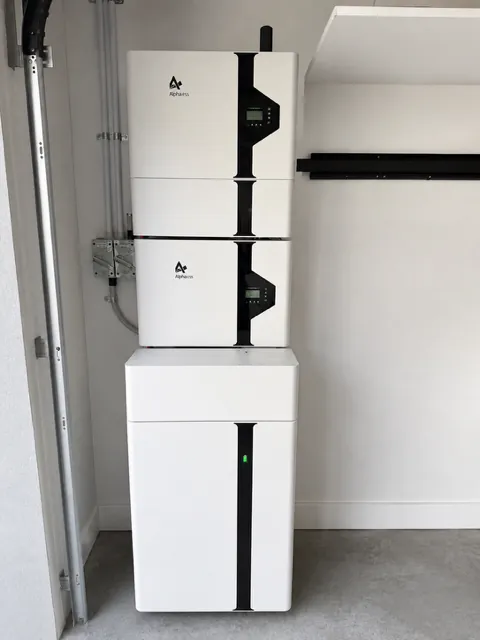
From one of our jobs
Battery and inverter stacked inside the garage
Photographed on site in Melbourne’s west. REC 37223.
That is not a blanket no. Plenty of Footscray homes with a good rear extension roof, a decent array and real evening consumption are sensible battery candidates. It is a reason to do the arithmetic properly before spending $8,000 to $12,000, which is what we would want if it were our money.
Does your array produce a surplus at all
Start with your bills or interval data. If your solar is already being consumed in the house through the day, with little or nothing exported, a battery has nothing to store and it will spend most of the year barely cycling.
If you are exporting meaningfully, particularly in the middle of the day, that exported energy is the raw material a battery converts into savings. On a 3kW to 5kW Footscray array the surplus is smaller than a suburban estate home produces, which usually points to 8kWh rather than 13kWh of usable capacity. Sizing to the surplus rather than to the evening load alone is the correction most inner-west quotes need.
Where a battery physically fits in a terrace
Battery standards require clearances around the unit, separation from habitable rooms and exit paths, and a temperature range the position can hold. In a Victorian terrace with party walls on both sides, a narrow rear yard and habitable rooms behind most external walls, that eliminates a lot of options quickly.
The usual answers are a rear laundry or lean-to wall, an external position under cover at the back, or a floor-standing unit in a rear shed or store. Weight is also a real factor: a wall-mounted battery commonly exceeds eighty kilograms, and single-brick or lath-and-plaster walls need proper assessment before anything is fixed to them.
Party walls are out
A shared wall with a neighbouring dwelling is not a battery location, regardless of how convenient it looks.
Rear yard, under cover
The most common workable position in a terrace, provided weather protection and clearances are properly handled.
Check the wall before the equipment
Old single-brick and timber walls need assessing for load before a heavy wall-mounted unit is specified.
Apartments and converted warehouses
In an apartment or a converted warehouse the questions come before the equipment. Is your supply individually metered, does the owners corporation control the space where a battery would go, are there fire and egress requirements specific to the building class, and would the battery serve your meter or common property.
Those are answerable, but they are building questions rather than electrical ones, and they need resolving before a design is worth drawing. In many Footscray apartment buildings the practical answer for an individual owner is that storage is not feasible without a building-level project.
Old boards, Jemena and honest numbers
Original fuse boxes and unearthed circuits still turn up routinely in unrenovated Footscray terraces. A battery cannot be connected to that, so board work at $800 to $3,500 or more sits ahead of the storage in both sequence and budget.
Footscray is a Jemena address, and a battery inverter needs its own Jemena application under AS/NZS 4777.2. On price, a 10kWh battery is $8,000 to $12,000 installed and $5,500 to $9,500 after the federal rebate at roughly $250 per usable kWh. Payback of 7 to 10 years assumes daily cycling, so on a small inner-west array expect the longer end unless the array is expanded as well.
On the ground
Footscray battery realities
- Small shaded terrace arrays of 3kW to 5kW produce a limited daily surplus, which caps sensible battery size at around 8kWh usable for many homes here.
- Party walls, habitable rooms behind most external walls and narrow rear yards make compliant siting the hardest part of a Footscray battery job.
- Apartments and warehouse conversions raise owners corporation, metering and building class questions that must be settled before any design work is worthwhile.
- Unrenovated terraces still have original fuse boxes and unearthed circuits. Board work at $800 to $3,500 or more comes before a battery, not alongside it.
Licensed and accredited work by a local team. Read about Pivot Trade Services or see recent jobs across the western suburbs.
Answers
Footscray questions
Check your exports first. If most of your solar is already used in the house during the day, a battery has little to store and will barely cycle. If you export meaningfully at midday, a battery around 8kWh usable can work. Sizing to the surplus rather than to the evening load is the correction most inner-west quotes need.
Usually a rear laundry or lean-to wall, an external position under cover in the rear yard, or a floor-standing unit in a rear shed. Party walls are excluded, and walls backing onto habitable rooms are constrained by fire separation requirements. Wall structure also matters, since a wall-mounted unit commonly exceeds eighty kilograms.
Often not as an individual owner. It depends on whether your supply is individually metered, whether the owners corporation controls the space, and what fire and egress requirements apply to the building class. Those questions have to be resolved before design. In many Footscray buildings, storage only makes sense as a building-level project.
Yes, and we do here more often than anywhere else we work. A battery is the most expensive item we sell with the longest payback. If your array is small and shaded, if you have no evening load to speak of, or if there is no compliant place to put it, we would rather say so than take a deposit and manage disappointment later.
Jemena, which covers Footscray along with Yarraville, Newport, Maidstone and Braybrook. A battery inverter is a grid-connected inverter under AS/NZS 4777.2, so it changes the inverter capacity at your connection point and needs its own application even where your solar was approved separately.
Other work we do in Footscray
- Electrician in FootscrayWhere the hard part is getting the cable from A to B
- Solar installation in FootscraySmall roofs, straight answers
- EV charger in FootscrayThe hardest suburb in the west to charge at home, and how to do it anyway
- Split system in FootscrayHigh ceilings, party walls and nowhere obvious for a condenser
- Heat pump hot water in FootscrayDense housing where getting there is the hard part
Get a Footscray quote
Tell us the address and what you need. We quote Footscray 3011 and the surrounding western suburbs in writing, with no obligation.
- Free
- On-site quotes
- Fixed
- Written pricing
- 100%
- Workmanship guarantee
- 5.0★
- 73 Google reviews